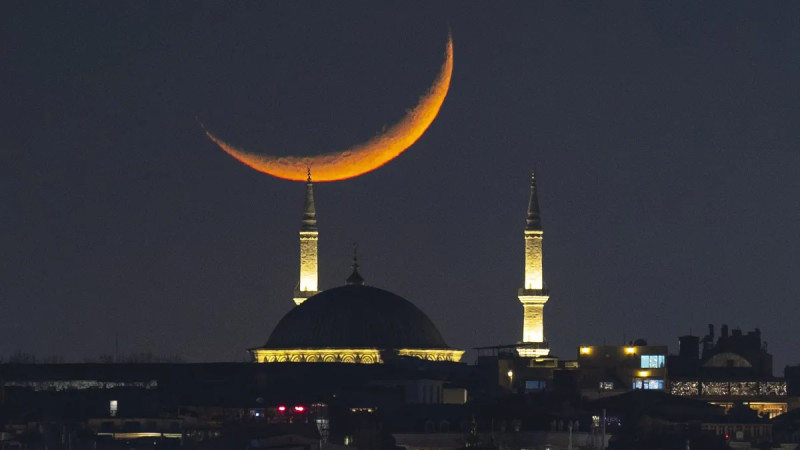
As the crescent moon remains elusive, Saudi Arabia is gearing up for a potential Eid al-Fitr on March 20, 2026, unless the moon is sighted a day earlier. With Ramadan's end in sight, the Muslim world awaits the official announcement from the Saudi Supreme Court, which will either confirm a 29 or 30-day holy month.
Crescent Moon Visibility: Saudi Arabia's Announcement
The new moon of March 2026 is key to determining Eid al-Fitr 2026. Saudi Arabia, a leading voice in Islamic lunar calendar matters, has not yet spotted the Shawwal crescent, suggesting a 30-day Ramadan. The Saudi Supreme Court will make the final call after sunset on March 18, 2026. Astronomical calculations indicate that visibility conditions may be challenging on March 18, 2026, complicating moon-sighting efforts.
The Significance of Moon Sighting in Saudi Arabia
For Muslims, the sighting of the crescent moon marks the end of Ramadan and the beginning of Eid al-Fitr—a festive period of joy, family gatherings, and charity. Saudi Arabia's role in determining the Eid moon sighting is pivotal, as its decision influences Muslim communities globally. Saudi Arabia has historically relied on both astronomical data and physical sightings to make this crucial announcement.
Let's not kid ourselves, the moon-sighting process has its share of controversies. Some Muslims argue that relying solely on astronomical calculations would provide more consistency, while traditionalists insist on physical sighting as a religious mandate. This debate highlights the tension between modernity and tradition within the Islamic world.
The Impact on Global Muslim Communities
Once confirmed, Saudi Arabia's announcement will ripple through global Muslim communities, setting the date for Eid al-Fitr 2026. In the United States, for instance, Muslims will follow the Saudi decree, making March 20, 2026, the likely date for celebrations. This synchronization underscores the unity of the Umma, the global Muslim community, despite geographical and cultural diversities. However, some regions may observe Eid a day earlier if local sightings differ.
“The sighting of the Eid-ul-Fitr moon will be observed on March 19. However, it is expected that the moon may not be visible that day, leading to a 30-day Ramadan in many regions.” — Mahali
But here's what nobody's asking: how might technological advancements, like advanced telescopes or satellite imagery, further standardize the moon-sighting process in the future? As the world becomes more interconnected, could we see a shift towards a more unified approach to determining Islamic holidays? Only time will tell.
As we look ahead to Eid al-Fitr 2026, let's remember that the moon sighting is more than just a date-setting ritual; it's a testament to the enduring traditions and unity of the Muslim community. Just as the moon has guided Muslims for centuries, it will continue to light the path of Eid celebrations in the years to come.


