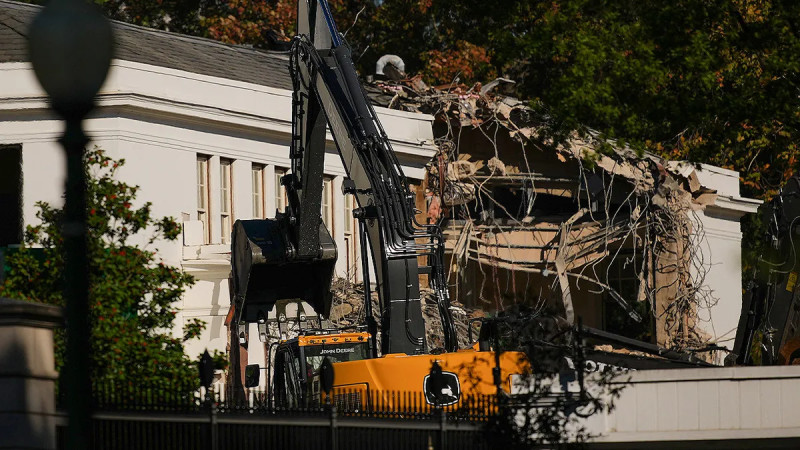
The White House ballroom construction, a project spearheaded by former President Donald Trump, has become a focal point of a legal battle that has captivated national attention. The construction, initially slated to cost a staggering $400 million, has faced numerous legal hurdles, with federal judges and courts weighing in on its legality and potential national security implications.
The Legal Landscape: A Federal Judge's Intervention
In a significant move, a federal judge in Washington issued a preliminary injunction, effectively halting construction of the White House ballroom. The judge, Richard Leon, cited the absence of "express authorization from Congress" as a key reason for the halt. In his ruling, Leon emphasized that Trump, despite being the President, is not the "owner" of the White House, and thus cannot proceed with such a substantial project without congressional approval.
This ruling sent shockwaves through the White House, prompting Trump to claim that the halt posed a risk to national security, further complicating the legal battle. The judge's decision was met with a mix of support and criticism, with some arguing that Trump overstepped his executive powers, while others saw it as a necessary check on presidential authority.
Appeals Court Rulings: A Back-and-Forth Battle
The legal saga took another turn when a federal appeals court temporarily extended the lower court's order, allowing the construction to proceed for another week while judges considered the project's implications. This extension provided a crucial window for the Trump administration to navigate the legal minefield and potentially secure the necessary approvals. The court's decision, however, came with a caveat: the judge overseeing the case was instructed to review the possible national security implications of halting the construction.
"This is a complex legal matter with far-reaching implications," noted a legal expert. "The White House ballroom construction not only involves significant financial investment but also raises critical questions about executive power and congressional oversight."
In a subsequent move, the federal court of appeals ruled that construction could proceed until at least April 17, giving the Trump administration more time to resolve the legal disputes. This decision, while providing temporary relief, did little to settle the underlying controversy, as legal challenges continued to mount. Despite the legal back-and-forth, the project secured final approval from a key agency, adding another layer of complexity to the ongoing battle.
“Construction has to stop!” the judge ordered, underscoring the gravity of the legal challenge facing the Trump administration.
Public and Political Reactions: A Nation Divided
The White House ballroom construction has polarized public opinion, with advocates citing the project's potential to enhance national security and critique the legal obstacles. Critics, on the other hand, question the necessity and legality of such a massive undertaking, especially in the face of existing national security concerns and budgetary constraints.
The battle over Trump's White House ballroom highlights the delicate balance between executive power and congressional oversight, a theme that has dominated much of the political discourse in recent years.
"We are at a critical juncture," said a senior administration official, "and the outcome of this legal battle will set a precedent for future presidential projects and the limits of executive authority."
The court's decision to allow construction to proceed until April 17, amidst this legal tussle, underscores the ongoing drama surrounding the Trump White House ballroom construction.
The legal battle over President Trump's White House ballroom construction continues to unfold, with no clear resolution in sight. As the courts grapple with the complexities of executive power and congressional oversight, the fate of the $400 million project hangs in the balance, leaving many to ponder the broader implications of this high-stakes legal drama.