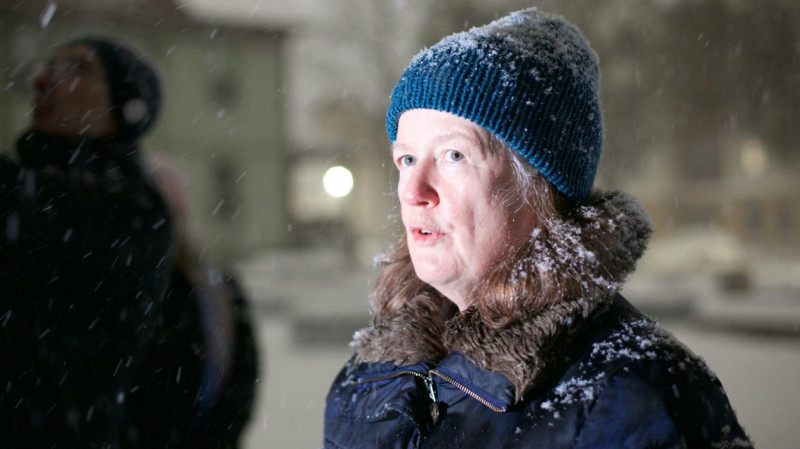
The room is sparse, nearly empty, save for a small bed, a chair, and a metal sink. At the center, an elderly woman sits, her hands folding and unfolding a piece of paper, a letter from her attorney. She's Marie-Thérèse, an 86-year-old French woman, detained by the U.S. Immigration and Customs Enforcement (ICE) for nearly two weeks .
Marie-Thérèse's Journey to Detention
Marie-Thérèse's story began decades ago when she married an American soldier stationed in France. They settled in the United States, and she built a life here. But her husband's death in January 2026 left her vulnerable and, ultimately, in ICE detention. As a widow, she no longer held a permanent visa, and the U.S. government didn't recognize her residence status. She was arrested at her home on April 1 and transported to a detention center in Louisiana.
In the quiet of the detention center, a guard approaches, "Marie-Thérèse, your lawyer is here to visit." She looks up, a glimmer of hope in her eyes. "I just want to go home," she says softly, her voice barely above a whisper. It's a sentiment echoed by her family, who have been rallying for her release, reaching out to the French embassy. "We just want Marie-Thérèse back home where she belongs," her family stated, their desperation palpable.
The Human Toll of ICE Detention
Marie-Thérèse's case is far from unique. Women in ICE detention often face harsh conditions and psychological trauma. Many are separated from their families, held in overcrowded centers that lack adequate medical care or gender-appropriate facilities. The experience can be dehumanizing, and the psychological impact is profound. “I’ve seen women held in solitary confinement for days, suffering severe psychological trauma,” a former detainee revealed, her voice shaking with emotion.
Marie-Thérèse's situation has drawn attention to the broader issue of elderly detainees. At 86, she is one of the oldest individuals held in ICE custody. Her family and supporters argue that her age and circumstances warrant compassionate release. "She's not a criminal," her nephew stated, his voice firm with conviction. "She's an elderly woman who just wants to live out her days in peace." The family's plea for her wellbeing is echoed by the French government, which has been in contact with the Quai d'Orsay to negotiate her release.
Diplomatic Efforts and Public Outcry
The French government has been actively involved in advocating for Marie-Thérèse's release. French diplomats have been in discussions with U.S. authorities, emphasizing the humanitarian aspect of her case. The French Foreign Ministry has expressed its support, stating, “We are deeply concerned about Marie-Thérèse's situation and are working tirelessly to secure her release.”
Public outcry has also been mounting. Advocacy groups and human rights organizations have been vocal about the treatment of elderly detainees and the broader issue of ICE detention. “Marie-Thérèse's case highlights the urgent need for reform in our immigration policies,” a spokesperson for an immigrant advocacy group stated, their voice resolute. “We need policies that recognize the humanity of all individuals, regardless of their immigration status.”
“The conditions in these detention centers are appalling. Women, in particular, face unique challenges and psychological trauma. It's a system that needs urgent reform.” – Immigrant Rights Advocate
Marie-Thérèse's door opens slightly, a faint ray of sunlight filters in, illuminating the stark room. She looks out, her eyes reflecting the hope of a brighter future. As the door closes, leaving her in the relative darkness, the silence is deafening. The question lingers, unanswered: how long will it take for Marie-Thérèse to be freed?