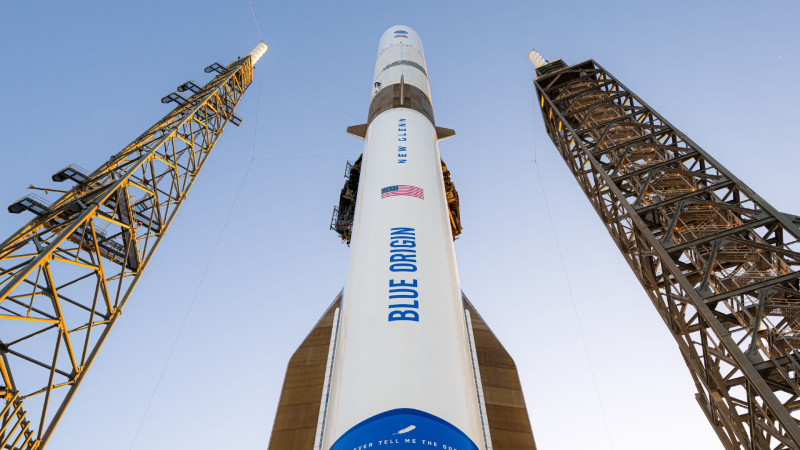
The countdown clock at Cape Canaveral Space Force Station ticked down to zero, and the ground rumbled as Blue Origin’s New Glenn rocket ascended into the sky, marking the third launch of this powerful vehicle and the first time the company has successfully reused a booster . The launch, designated NG-3, took place in the early morning of April 19, 2026, from Launch Complex 36 in Florida. This mission is a crucial step for Blue Origin as it aims to compete with SpaceX in the market of reusable rockets, setting the stage for a new chapter in space exploration.
New Glenn's Third Mission: A Critical Milestone
The New Glenn rocket, named after John Glenn, the first American to orbit the Earth, has been a long-awaited addition to Blue Origin’s fleet. With a height of more than 95 meters and a payload capacity of up to 45 metric tons, it is designed to carry both crew and cargo into space. The NG-3 mission, which is the third flight of the New Glenn rocket, is especially significant because it is the first time Blue Origin has reused a previously flown booster. This achievement aligns Blue Origin with SpaceX, another key player in the space industry, in the realm of reusable rocket technology . The successful recovery and reuse of the booster not only demonstrate the New Glenn's reliability but also signal a significant cost-saving measure for future missions.
Launch Details and Mission Objectives
Launch Complex 36, the site from which the New Glenn rocket lifted off, is a testament to Blue Origin’s investment in infrastructure. Rebuilt from the ground up at a cost of over $1 billion, the complex is home to the launch pad, vehicle integration facilities, and more. Completed in 2021, LC-36 is the first newly rebuilt launch complex since the 1960s . The NG-3 mission’s primary objective was to deploy a constellation of broadband satellites for AST SpaceMobile. These satellites will provide global coverage for mobile communications, enhancing connectivity in remote areas . The successful deployment of these satellites marks a significant advancement in telecommunications infrastructure, leveraging space to bridge the digital divide.
Blue Origin’s Future Plans and Competitive Landscape
With the successful launch of the NG-3 mission, Blue Origin is poised to expand its role in the space industry. The company’s goal is to make space travel more accessible and affordable by reusing rocket boosters, a strategy that has already proven successful for SpaceX. Blue Origin’s New Glenn rocket, with its impressive payload capacity and reusability, is well-positioned to compete in the commercial launch market. The company has ambitious plans, including crewed missions to the Moon and beyond. As Blue Origin continues to push the boundaries of space exploration, the successful reuse of the New Glenn rocket booster is a major step toward achieving these goals. The company’s commitment to innovation and sustainability in space travel is evident in this milestone, setting the stage for future advancements in the industry.
As the New Glenn rocket soared into space, the hum of excitement and anticipation in the briefing room was palpable. The mission's success not only solidifies Blue Origin’s position in the space industry but also paves the way for future innovations — and perhaps, a new era of space exploration.
"The reuse of the New Glenn booster is a significant achievement for Blue Origin and a testament to our commitment to making space travel more sustainable and accessible," said a spokesperson for Blue Origin .