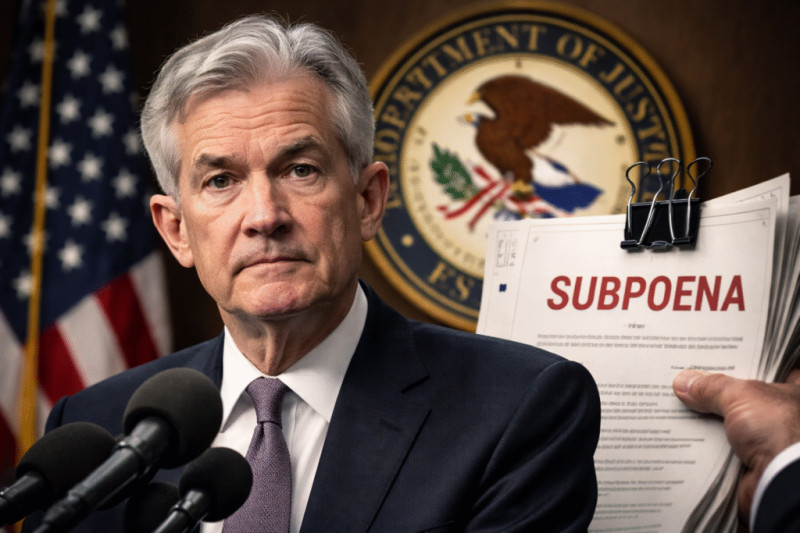
Federal Judge James E. Boasberg has blocked a series of subpoenas issued by the Department of Justice (DOJ) targeting Federal Reserve Chair Jerome Powell, effectively crippling the criminal investigation against him.
The subpoenas, issued as part of a broader criminal probe, were challenged in court, leading to a significant ruling that has wide-ranging implications for the DOJ's pursuit of the case.
The controversy centers around Jerome Powell, a figure whose prominence in the financial world has made him a focal point of both political and legal scrutiny. Powell is the chair of the Federal Reserve, the central banking system of the United States, which plays a crucial role in shaping the nation's monetary policy and economic stability.
Despite the ruling, the DOJ has indicated its intention to appeal the decision, suggesting that the battle over the subpoenas and the broader investigation into Powell may not be over.
The subpoenas, issued by the U.S. attorney's office in Washington, were part of a criminal probe led by U.S. Attorney Jeanine Pirro. The investigation was initially revealed in early January, prompting significant political reactions, including a move by Senator Thom Tillis to block the consideration of President Trump's nominee to replace Powell as Fed Chair when his term expires in May.
In his ruling, Judge Boasberg was particularly critical of the DOJ's handling of the case, noting that the government "produced essentially zero evidence" to support the criminal investigation. Boasberg's decision suggests that the subpoenas were issued without a legitimate basis, raising questions about the motives behind the probe.
The judge’s decision holds profound implications for the ongoing political and legal landscape, particularly as it perturbs the balance between executive and judicial powers. The ruling casts a spotlight on the Federal Reserve's autonomy and the boundaries of executive power in pursuing investigations against high-profile figures.
Powell’s role as the chair of the Federal Reserve has been pivotal in navigating the economic challenges of recent years, including the fallout from the COVID-19 pandemic. His term as chair has seen significant economic policy changes, making him a central figure in the nation's economic recovery.
The implications of this legal battle extend beyond the immediate case, touching on broader issues of government oversight and the independence of central banking institutions. As the DOJ prepares to appeal, the legal and political community will be closely monitoring the developments, which could reshape the contours of executive power and judicial review.
For now, the court’s decision has cleared the path for Powell to continue his tenure without immediate legal distractions, but the looming appeal could reintroduce uncertainty in the coming months.