United Airlines Plane Clips Tractor-Trailer and Light Pole on Descent into Newark
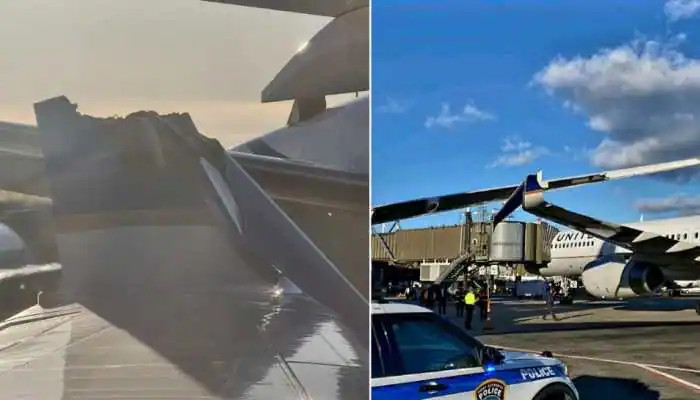
Imagine, if you will, a United Airlines Boeing 767 descending from the Venetian sky, its engines a distant hum, its wings slicing through the New Jersey twilight. The routine meeting of metal and asphalt turned chaotic in an instant. In a split second, what should have been a smooth touchdown instead became a jarring collision when the plane hit a truck and a light pole on the New Jersey Turnpike near Newark Liberty International Airport.
The Descent Turns Chaotic: A Close Call at Newark
A United Airlines flight from Venice, Italy, turned a routine landing into a dramatic spectacle on the afternoon of Sunday, May 3, 2026. United Flight 169, carrying 221 passengers and 10 crew members, was approaching Newark Liberty International Airport when it clipped a tractor-trailer and a light pole on the New Jersey Turnpike. The incident left the truck driver with minor injuries, but miraculously, no one else was hurt.
The collision gave rise to a flurry of activity, but it’s worth noting that the damage could have been far worse. The plane, a Boeing 767-400, was able to land safely despite the unexpected encounter, underscoring the resilience of modern aviation.
Where the aircraft and the highway converge, there exists a thin line between routine and catastrophe. "The planes that fly overhead are mere whispers of the sky, and the roads below are the veins of a city. When they meet, it’s a dance of precision and risk," stated a seasoned aviation analyst, emphasizing the delicate balance of air traffic control.
Investigating the Near Miss: Safety and Protocol
Federal authorities have initiated a comprehensive investigation into the incident, aiming to uncover the sequence of events that led to the collision. While the United Airlines plane clipped a truck and a light pole, the investigation seeks to determine whether human error, mechanical failure, or a combination of factors played a role.
As the investigation unfolds, it highlights a critical aspect of modern aviation: the intricate dance between technology and human skill. The pilots, ground crew, and air traffic controllers must coordinate seamlessly to navigate the complex airspace around Newark Liberty International Airport, one of the busiest in the world.
In the aftermath, the incident raises questions about safety protocols and the potential need for additional measures to prevent such occurrences. The New Jersey Turnpike, a vital artery for both local and interstate traffic, intersects with the flight path of Newark’s busy airport. This intersection presents a unique challenge for aviation safety, one that demands constant vigilance and innovation.
Avoiding Future Collisions: Technology and Training
To mitigate the risks associated with such high-traffic areas, aviation experts are advocating for enhanced safety measures. These include advanced radar systems, improved communication protocols, and rigorous training programs for pilots and air traffic controllers. The goal is to minimize the chances of future incidents, ensuring that the dance of precision and risk remains a silent ballet and not a chorus of chaos.
While technology plays a crucial role, the human element remains indispensable. Pilots must be adept at navigating challenging conditions, and air traffic controllers must maintain unyielding focus. The collision serves as a reminder of the delicate balance between the two, and the importance of continuous training and adaptation. If this incident highlights anything, it is the importance of preparedness and the ability to adapt to the unexpected.
The United Airlines Boeing 767 arriving from Venice, Italy, serves as a stark reminder of the delicate balance between precision and risk in modern aviation. Federal authorities are investigating the collision to understand what went wrong. As the investigation unfolds, the focus remains on the delicate balance of technology and human skill, and the need for continuous vigilance in ensuring air safety.
How does this story make you feel?
 Up next · WorldColorado’s I-25 Snow Warning: Severe Weather Alerts for Denver and Beyond