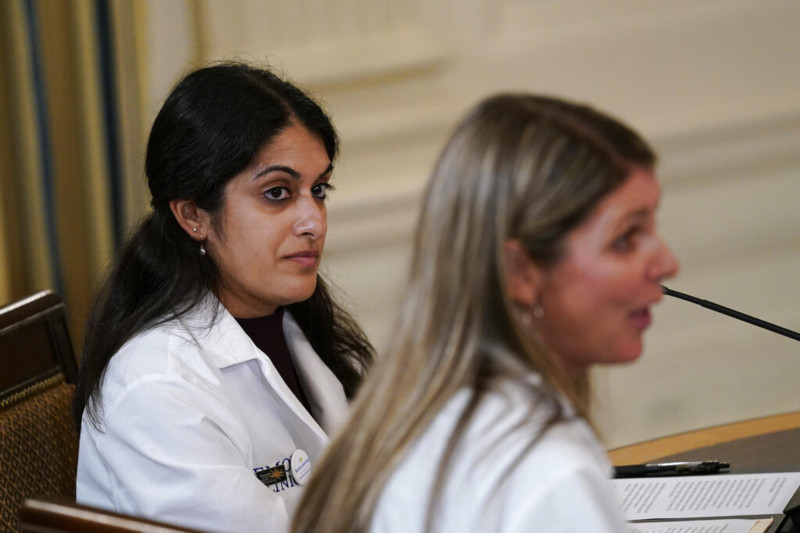
In the latest controversy to erupt from Capitol Hill, Dr. Nisha Verma, an esteemed OB/GYN, found herself in the eye of a storm during a United States Senate Committee hearing . The hearing, centered around the safety of medication abortion, took an unexpected turn when Senator Josh Hawley questioned Dr. Verma on whether men can get pregnant. The exchange quickly went viral, sparking a heated debate and drawing national attention to Dr. Verma, an Indian-origin doctor known for her expertise in reproductive health .
Dr. Verma's refusal to provide a direct answer to the question, which seems straightforward to many, has ignited a firestorm of criticism and discussion. The incident has highlighted the complexities of contemporary debates around reproductive health and the role of medical professionals in political discourse. The Senate hearing, initially focused on the safety and efficacy of medication abortion, became a platform for a broader discussion on gender, biology, and the boundaries of medical testimony .
Born in India, Dr. Verma is a double board-certified, fellowship-trained obstetrician and gynecologist. She holds the esteemed position of a fellow with Physicians for Reproductive Health and is a professor at Emory University . Her extensive background in reproductive medicine makes her a formidable expert in the field, but it is her recent refusal to answer a seemingly simple question that has thrust her into the national spotlight .
During the tense exchange, Senator Hawley pressed Dr. Verma, asking repeatedly if men can get pregnant. Her evasive responses drew sharp criticism from Republicans, who argued that her refusal to acknowledge basic biological facts was indicative of a political bias. Dr. Verma's supporters, however, saw her reluctance as a strategic move to avoid engaging in a question that was designed to trap her in a political debate rather than a medical one .
The controversy has sparked a broader conversation about the role of medical professionals in political hearings. Critics argue that doctors should stick to medical facts and avoid being drawn into political debates. Supporters, on the other hand, believe that medical professionals have a responsibility to provide nuanced answers that reflect the complexity of the issues at hand. Verma's response, which eschewed a simple yes or no, has been interpreted by some as a refusal to engage in a simplistic debate that oversimplifies medical issues .
In the aftermath of the hearing, Dr. Verma has become a symbol of the ongoing debates around reproductive health and the role of medical professionals in political discussions. The controversy has also raised questions about the intersection of medicine and politics, and how medical experts should navigate the complexities of testifying before Congress .
As the debate continues, one thing is clear: Dr. Nisha Verma's name will be synonymous with this contentious moment in American politics. Her controversial stance reflects the broader struggles around reproductive healthcare and highlights the challenges faced by medical professionals when they are called to testify in political hearings. The controversy serves as a reminder that discussions around reproductive health are fraught with complexity and that medical professionals must navigate these issues with care and nuance .