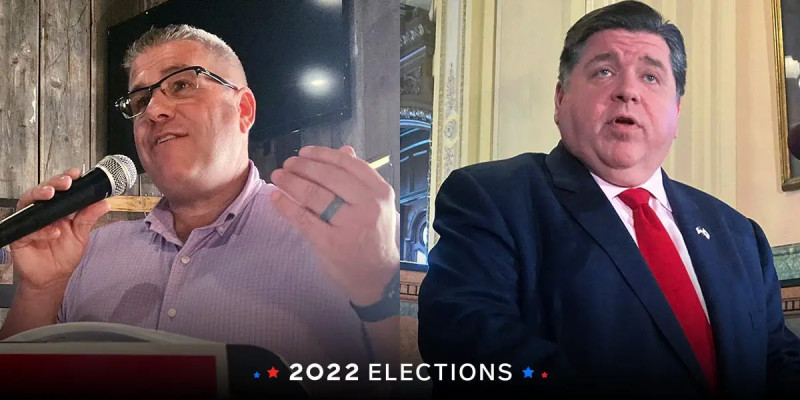
In a twist of political fate, Darren Bailey has secured a second chance to challenge incumbent Illinois Governor JB Pritzker in the 2026 governor's race. After a narrow loss in 2022, Bailey, a former state legislator, managed to win the Republican nomination on March 18, 2026.
The Road to the 2026 Primary
The 2026 primary election for the Republican gubernatorial nomination in Illinois was a tight contest. Among the candidates were Ted Dabrowski, Rick Heidner, and James Mendrick, all vying for a shot against Pritzker in the general election. However, Bailey, a farmer from southern Illinois and a strong Trump ally, emerged as the frontrunner. With his downstate roots and hardline stance, Bailey captured the Republican base, projected as the winner of the primary from early on.
A Strategically Crafted Campaign
Bailey's campaign has been marked by a blend of populist rhetoric and a strong stance on conservative issues. His pitch to 'Restore Illinois' has resonated with many voters, who see him as a champion of safety, affordability, and prosperity.
Bailey's alignment with President Trump has been a double-edged sword. While it has galvanized his base, it has also drawn criticism from those who view him as too extreme. His rhetoric, often described as polarizing, has made him a controversial figure in Illinois politics.
Despite the criticism, Bailey's campaign has consistently highlighted his underdog status and grassroots approach. He has framed the race as a battle between 'elite' politicians like Pritzker and everyday citizens, a narrative that has struck a chord with many voters.
The Rematch with Pritzker
The 2026 gubernatorial race is shaping up to be a rematch of the 2022 election, where Pritzker narrowly defeated Bailey. Pritzker, a billionaire businessman and philanthropist, has been governor since 2019. He has positioned himself as a pragmatic progressive, focusing on issues like education, healthcare, and economic development. His administration has faced criticism for its handling of the pandemic and fiscal policies.
Despite the challenges, Pritzker has the advantage of incumbency, a substantial war chest, and a relatively strong approval rating. However, he is not without vulnerabilities. His support for controversial policies and his billionaire status have made him a target for Republican attacks.
Bailey, on the other hand, will enter the race as the underdog but with a newfound momentum from his primary victory. His campaign has already begun to frame the race as a choice between two distinct visions for Illinois.
Look, if Pritzker can be described as a steady hand, then Bailey is the fiery upstart. But the question on everyone's mind is whether Bailey's populist message will be enough to sway the voters in a state that has trended Democratic in recent years.
Sound familiar? Remind you of anything? This political dynamic is far from new, but voters know the stakes are high for the future of Illinois and the political landscape looks more divisive than ever.
Bailey's campaign has already begun to frame the race as a choice between two distinct visions for Illinois.
As always, the outcome of the 2026 governor's race will be shaped by a myriad of factors, including the performance of the candidates, the political climate, and the issues that resonate most with voters. And then — get this — Bailey's victory in the primary has already injected a new level of intensity into the contest. If Bailey wins, he will be the first Republican governor of Illinois in nearly 20 years. But if Pritzker holds on to his seat, it will be a major victory for the Democrats in a state that has become increasingly contested in recent years.
If Bailey and Pritzker face off in 2026, it will be a battle of political heavyweights, and a testament to the enduring power of the grassroots movement and the appeal of populist rhetoric.
What’s Bailey going to have to do to pull off this upset? The answer to that question, as the old saying goes, is blowing in the wind.