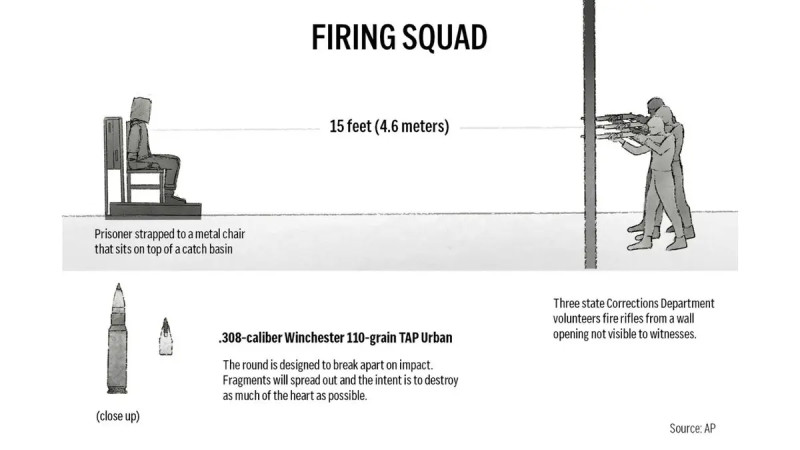
In a move that harked back to a bygone era of justice, the Justice Department announced on April 24, 2026, that it would allow the use of firing squads for death penalty executions in federal cases, sparking a fresh debate over the morality and efficacy of capital punishment. This decision, part of a broader push to expedite capital cases, has raised both legal and ethical questions about the methods employed to carry out the ultimate penalty.
The Resurgence of Firing Squads: A Blunt Tool in the Justice Toolbox
The move to reinstate firing squads as a method of execution, along with electric chairs and lethal injections, is nothing short of a dramatic shift in federal penal policies. This is not a decision that the Justice Department took lightly, but rather a calculated effort to streamline and expedite capital punishment cases. The use of firing squads in execution has been a rare occurrence in recent decades, with the last known federal execution by firing squad occurring in 2004. The Justice Department's decision to expand the execution methods not only seeks to align with state practices but also raises questions about the efficacy and moral implications of this method.
Legal and Ethical Debates Surrounding Firing Squad Executions
Firing squads have a controversial history, deeply rooted in the cultural fabric of American justice. This method of execution was prevalent in the early 20th century, but its use gradually waned as more humane methods were introduced. Now, with the Justice Department's decision, the debate over the use of firing squads in executions has reemerged, challenging our understanding of justice and the death penalty. The resurgence of firing squads as a method of execution brings to the forefront the debate over the humaneness of capital punishment. The use of pentobarbital as a lethal injection drug has been a contentious issue, with shortages and legal challenges causing delays in death penalty cases. The Justice Department's decision to expand the execution methods to include firing squads and electric chairs aims to address these challenges.
"The Justice Department must balance the need for finality in death penalty cases with the ethical considerations of using such a method. This decision is a testament to the complexities of administering justice in a democratic society."
Could Other States Follow Suit?
The question remains: could other states follow suit? The Justice Department's decision has sparked interest in states like Florida, where the death penalty is still widely used. If Florida were to adopt similar measures, it would mark a significant shift in the state's penal practices. While the Justice Department's move is primarily focused on federal cases, its implications for state-level executions are profound. This decision could set a precedent for states to re-examine their own execution protocols, potentially leading to a broader acceptance of firing squads as a method of execution.
As the Justice Department continues to push forward with its plans to expedite capital punishment cases, the debate over firing squads and the death penalty shows no signs of abating. With the decision to allow the use of firing squads for executions, the Justice Department has added a new chapter to the contentious history of capital punishment in the United States. The future of the death penalty, and the methods used to carry it out, remains a hotly debated issue, with legal, ethical, and moral questions lingering in the air. If the justice department firing squad is indeed reinstated, it will be a grim reminder of the enduring legacy of the death penalty in American society. As the world watches, the question of whether this method of execution will gain broader acceptance or remain a rare and controversial practice hangs in the balance. The upcoming trials and executions will undoubtedly be watched closely, not just for their legal outcomes but for the deeper questions they raise about justice and humanity in the 21st century.