The Ceuta Conundrum: Spain's Migrant Crisis on the Morocco Border
Imagine a city at the heart of a geopolitical storm, where borders blur, and desperation meets opportunity. This is Ceuta, a Spanish enclave in North Africa, a flashpoint in the ongoing migrant crisis. On the map, it’s a tiny speck on Morocco’s northern coast, but its significance is anything but small. Ceuta's unique position has made it a focal point for migrants fleeing Morocco and beyond, seeking a better life in Spain. This crisis has deep roots and complex layers, from economic disparities to political tensions, and it's a story that demands our attention.
Ceuta on the Map: A Spanish Outpost in North Africa
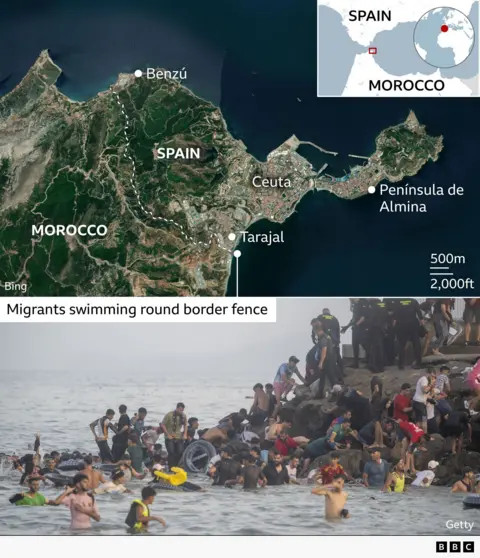
Ceuta is one of two Spanish autonomous cities in North Africa, the other being Melilla. It’s a Spanish enclave surrounded by Morocco, a peculiar geographical anomaly that has turned it into a hotspot for migrants. The city’s strategic location has made it a gateway to Europe, and its borders have become a flashpoint for the migrant crisis.
Ceuta’s geography is dramatic. It’s a rocky outcrop jutting into the Mediterranean, separated from the African mainland by a narrow strip of water. The city is a mix of Spanish and Moroccan influences, with a rich history that dates back to Phoenician times. Despite its small size — just 18.5 square kilometers — it’s a bustling place, home to around 85,000 people.
Now, picture this: a city where the streets are lined with Moroccan- style houses and Spanish cafes, where the official language is Spanish, but Arabic is widely spoken. It’s a blend of cultures, a testament to its unique position in the world.
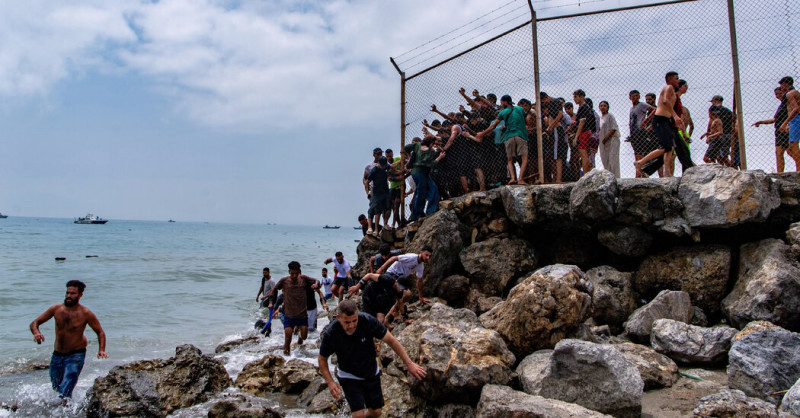
But Ceuta’s charm is overshadowed by its role in the migrant crisis. The city’s borders are heavily fortified, a stark reminder of the tensions that simmer just beneath the surface. The border fence, a series of barriers and watchtowers, is a constant reminder of the divide between North Africa and Europe.
Sound familiar? Remind you of anything? This is a scene playing out in various spots along the Mediterranean Sea. But Ceuta is a bit different. It’s a unique flashpoint where the tensions of migration, politics, and borders all intersect.
From Morocco to Spain: The Migrant Exodus
Why are Moroccans fleeing to Spain? The reasons are as complex as they are heartbreaking. One of the most significant factors is the stark economic disparity between Morocco and Spain. Morocco, despite recent economic growth, still grapples with high unemployment and poverty. For many, the promise of a better life in Europe is irresistible.
Here’s the thing: the journey to Ceuta is fraught with danger. Migrants often risk their lives crossing the treacherous waters of the Mediterranean. The journey is expensive, and many migrants are exploited by smugglers. But the lure of a better life is strong, and desperate people take desperate measures.
Now, let’s talk about the numbers. In recent years, the number of migrants attempting to cross into Ceuta has surged. The Spanish authorities have reported a significant increase in attempted border crossings, with many migrants using ladders, boats, or even swimming to reach the Spanish side.
Look, it’s not just about the numbers. It’s about the human stories behind them. Imagine the courage it takes to leave everything behind, to embark on a perilous journey in search of a better life. It’s a testament to the human spirit, but it’s also a stark reminder of the inequalities that drive people to such extremes.
Morocco’s Role in the Crisis
Morocco’s role in the migrant crisis is complex and multifaceted. On one hand, Morocco is a transit country for migrants from sub-Saharan Africa, many of whom hope to reach Europe. On the other hand, Morocco is also a destination for migrants from other parts of Africa, drawn by the country’s relative economic stability and cultural ties.
And then — get this — Morocco has been criticized for its handling of the migrant crisis. Human rights groups have accused Morocco of pushbacks and mistreatment of migrants, claiming that many are forcibly returned to their countries of origin without due process.
The Moroccan authorities, for their part, maintain that they are doing their best to manage the crisis, but they face significant challenges. The influx of migrants has put a strain on Morocco’s resources, and the country is grappling with its own economic and political issues.
But here’s the thing about borders: they’re not just lines on a map. They’re a reflection of the politics, the economics, and the human stories that shape our world.
Ceuta is a microcosm of the broader migrant crisis, a stark reminder of the complex interplay between borders, politics, and human desperation. And as the crisis continues to unfold, the world watches, and wonders what comes next.
“We are witnessing a profound human tragedy, and it is critical that we address the root causes of migration, rather than simply managing the symptoms.” - Amnesty International report on the migrant crisis in the Mediterranean, 2025.
So, what happens next? What does the future hold for Ceuta, for Morocco, and for the migrants who brave the treacherous waters to reach a better life? These questions weigh heavy on the minds of policymakers, activists, and ordinary people alike.
How does this story make you feel?
 Up next · WorldBorderline Chaos: Inside the Ceuta Crisis