Ebola Resurgence: A Deadly Wave Sweeps the Democratic Republic of Congo
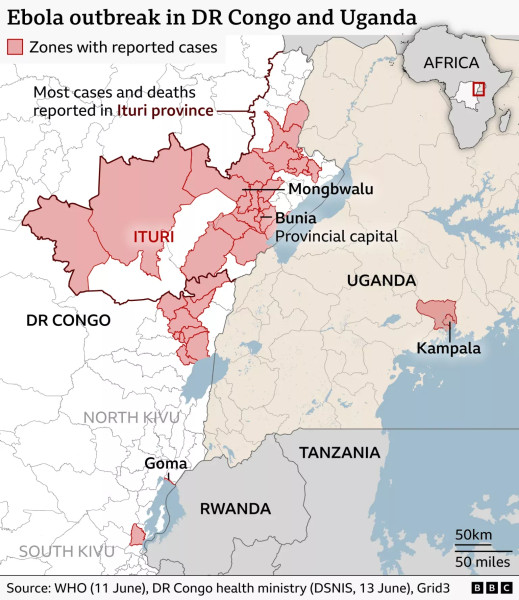
The Democratic Republic of the Congo (DRC) is once again grappling with a deadly disease outbreak. This time, it is a particularly virulent strain of Ebola, the Bundibugyo species, which has swept through the country with unprecedented speed. As the outbreak intensifies, the world watches with bated breath, hoping for a miracle to halt its relentless march.
A Public Health Challenge of Epic Proportions
The outbreak has become the fastest-spreading on record, with infections surging to record highs. The World Health Organization (WHO) has issued dire warnings, noting that a majority of new cases are emerging from "unknown chains of transmission," further complicating containment efforts. The situation is dire, with the death toll surpassing 2,000 among confirmed cases, making it the deadliest Ebola outbreak in the region's history.
While the outbreak has primarily affected the DRC, neighboring Uganda is also grappling with its own Ebola challenges, with cases reported in recent times. The conflict-ridden regions of eastern DRC, where the outbreak is most concentrated, pose significant challenges to public health efforts. The instability hinders the ability of health workers to reach affected areas, implement containment measures, and treat those who fall ill.
Global Efforts and Challenges in Containment
Despite the grim situation, global health organizations are not standing idle. Efforts are being made to enhance treatment and develop a vaccine tailored to the Bundibugyo species of Ebola. The WHO, along with other international bodies, is actively working towards this goal, but results may still be months away.
In the meantime, real-time case counts, interactive maps, and news updates are being provided by organizations such as the WHO, Africa CDC, CDC, and MSF. These tools are crucial in tracking the outbreak's progress, identifying hotspots, and guiding response efforts. However, the challenge lies in effectively utilizing this data in a conflict-ridden and resource-strapped environment, where even the most advanced medical interventions can be rendered ineffective without stability and security.
The Path Forward: Hope and Uncertainty
As the world watches and waits, the question remains: will this outbreak be the turning point in the fight against Ebola, or will it continue to claim lives with impunity? The situation in the DRC is a stark reminder of the ongoing struggle against deadly disease outbreaks and the need for sustained global efforts to combat them. The WHO and other health organizations are at the forefront of this battle, but the path forward is fraught with challenges, particularly in regions plagued by conflict and instability. The world can only hope that the efforts to develop a vaccine and enhance treatment will bear fruit, offering a glimmer of hope amidst the darkness of this devastating outbreak.
As we grapple with the Ebola latest news today, it is worth remembering the words of the renowned epidemiologist John Snow, who famously traced the source of a cholera outbreak in 1854 to a contaminated water pump on Broad Street in London. "The mortality was in fact the result of a poison introduced into the water," he declared, a sobering reminder of how a seemingly intractable problem can be solved with the right tools and determination, much like our current struggle against Ebola.
How does this story make you feel?
 Up next · HealthThe USS Abraham Lincoln: A Troubling Trend of Desperation at Sea