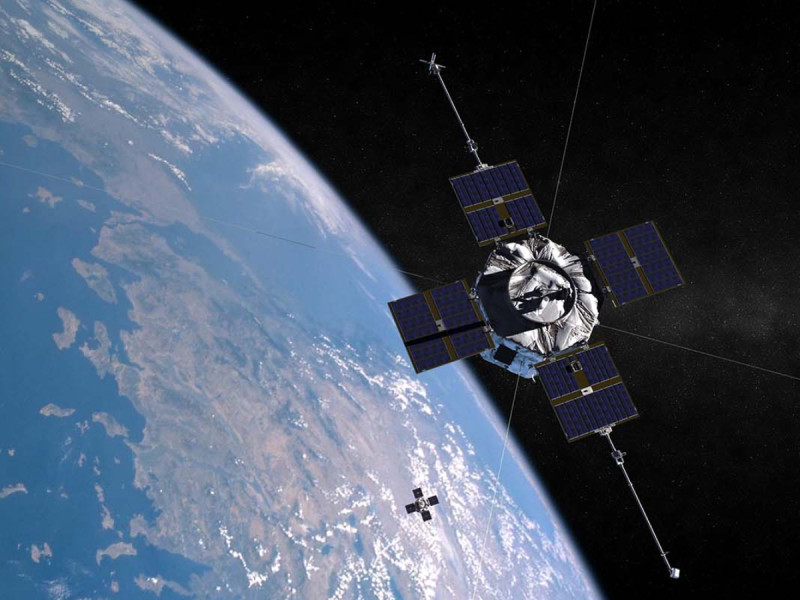
The Nasa satellite crash has been a trending topic as NASA's Van Allen Probe A is set to make an uncontrolled re-entry into Earth's atmosphere on March 10, 2026.
This event marks the end of a remarkable mission that began in August 2012. Originally designed for a two-year mission, the twin spacecraft, Van Allen Probes A and B, exceeded expectations by operating for almost seven years, gathering unprecedented data on Earth's radiation belts. Initially launched to study the Van Allen radiation belts, the spacecraft provided critical insights into the behavior of these high-energy particle zones, named after physicist James Van Allen.
The re-entry of the 1,300-pound satellite is a significant event, not just for NASA but for the scientific community as a whole. The mission's longevity has enabled researchers to deepen their understanding of space weather and its impact on Earth's atmosphere and technological systems. The mission's extended operation underscores NASA's commitment to pushing the boundaries of space exploration and data collection, even as it navigates the challenges of aging spacecraft.
Despite the excitement surrounding the re-entry, NASA has reassured the public that the risk to life and property is minimal. The agency estimates that the likelihood of any debris causing harm is approximately 1 in 4,200, emphasizing that most of the satellite's components will burn up upon re-entry.
As the world watches the fiery descent of the Van Allen Probe A, it serves as a reminder of the enduring legacy of space missions. The data collected by these probes will continue to inform future studies and improve our understanding of the complex interactions between Earth and space. For now, the focus remains on monitoring the re-entry and ensuring public safety, while also celebrating the success of a mission that has truly pushed the boundaries of scientific inquiry.
Thus the Nasa Satellite Crash is a remarkable event that signifies not just the end of a mission, but also the beginning of new insights and advancements in space science.