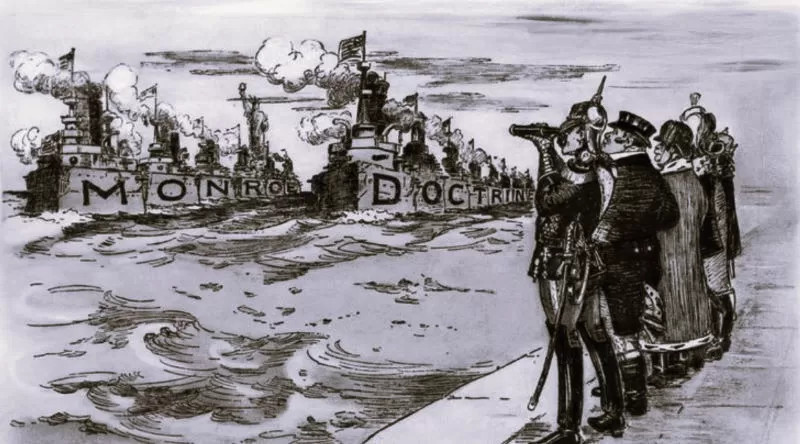
The Monroe Doctrine stands as a pivotal moment in U.S. foreign policy, first articulated by President James Monroe in 1823. It asserted the United States' opposition to European colonialism in the Western Hemisphere and declared that any European intervention in the Americas would be viewed as a hostile act. This doctrine remains a cornerstone of American foreign policy, influencing geopolitical dynamics for centuries.
Originally, the Monroe Doctrine was a response to European powers' continued colonial ambitions in the Western Hemisphere. It aimed to establish the U.S. as a guardian of the Americas, ensuring that European nations would not interfere in the region's political affairs or expand their colonial holdings. This policy was crucial in shaping the U.S.'s role as a hemispheric leader, preventing European interference, and promoting American interests in the region.
The doctrine's significance has evolved over time, with different U.S. administrations reinterpreting it to suit their geopolitical aims. For instance, the Roosevelt Corollary, introduced by President Theodore Roosevelt, expanded the doctrine to include the right of the U.S. to intervene in Latin American countries to maintain stability and prevent European intervention. This adaptation reinforced the U.S.'s role as a regional policeman, ensuring that European powers did not gain a foothold in the Americas.
In recent times, the Monroe Doctrine has been invoked in various contexts, particularly in relation to Venezuela. The political crisis in Venezuela, including the controversial capture claims of President Nicolás Maduro, has reignited debates about the doctrine's relevance and application. Some argue that the U.S. should adhere to the original principles of the Monroe Doctrine, opposing European or other foreign interventions in the Western Hemisphere, while others suggest that a more nuanced approach is necessary, considering the complex geopolitical landscape.
The Don-roe Doctrine, a rebranding of the Monroe Doctrine by former U.S. President Donald Trump, exemplifies this modern reinterpretation. This doctrine was unveiled after the regime change in Venezuela, accusing Maduro of hosting foreign adversaries and using weapons that threatened U.S. security. This rebranding highlights the ongoing relevance of the Monroe Doctrine as a tool for asserting American influence and protecting its interests in the Western Hemisphere, even in the face of evolving geopolitical challenges.
The Monroe Doctrine's enduring legacy underscores its relevance in shaping U.S. foreign policy and hemispheric relations. As the geopolitical landscape continues to evolve, the doctrine serves as a guiding principle for the U.S. in navigating complex international dynamics, asserting its influence, and protecting its interests in the Western Hemisphere.