Gone. The AI Revolution in Translation
Translators are at the forefront of a seismic shift driven by artificial intelligence (AI). The traditional translator, once a paragon of linguistic prowess and cultural nuance, is now navigating a landscape where machines can churn out translations in seconds. Think again. This transformation is not just about efficiency; it's about redefining what it means to translate in the 21st century.
AI-powered language models are rapidly evolving, capable of translating entire documents with a level of accuracy that once seemed unattainable. These systems, trained on vast datasets, can handle multiple languages and dialects with remarkable speed and precision. But can they truly replace human translators? Gone. The answer is not so straightforward. While AI has undeniably enhanced translation capabilities, it also poses significant challenges and raises ethical questions.
The Rise of Machine Translation
Machine translation has come a long way since its inception. Early systems were rudimentary, often producing translations that were grammatically incorrect or contextually inappropriate. However, recent advancements in natural language processing (NLP) and deep learning have led to significant improvements. Today, AI-driven translators can generate translations that are almost indistinguishable from those produced by humans.
One of the most notable developments in this field is the advent of neural machine translation (NMT). Unlike traditional rule-based or statistical methods, NMT uses deep learning algorithms to understand the context and nuances of language. This allows for more accurate and fluent translations, even in complex and idiomatic expressions.
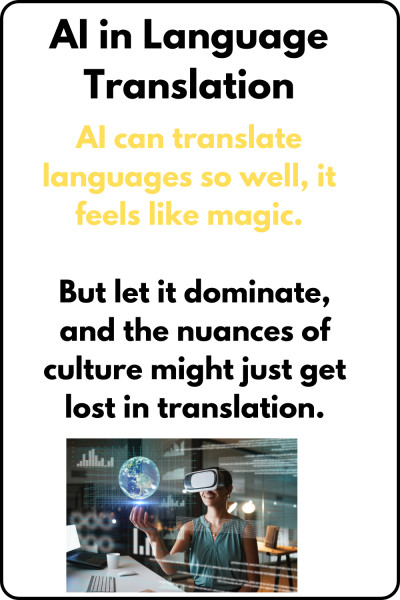
This evolution is not without controversy. Critics argue that reliance on AI could lead to a loss of linguistic diversity and cultural nuance. Translation is not just about converting words from one language to another; it's about conveying meaning, emotion, and cultural context. AI, with its lack of human intuition and emotional understanding, may struggle to capture these subtleties.
Impact on the Job Market
The rise of AI translation is having a profound impact on the job market for human translators. Many companies are now opting for AI-driven solutions due to their cost-effectiveness and speed. This shift has led to a decline in demand for traditional translators, raising concerns about job security and the future of the profession.
However, it's not all doom and gloom. Human translators are adapting by focusing on areas where AI falls short. For instance, they are taking on roles that require high levels of cultural sensitivity, creativity, and critical thinking. These include translating literary works, legal documents, and technical manuals, where human intuition and expertise are invaluable. The role of the translator is evolving from a simple word converter to a cultural mediator.
Moreover, the demand for post-editing services is on the rise. This involves human translators reviewing and refining AI-generated translations to ensure accuracy and cultural appropriateness. It's a collaborative approach that leverages the strengths of both AI and human translators, creating new opportunities in the field.
In recent times, the translation industry has seen a surge in demand for multilingual content. Businesses are expanding into global markets, and the need for accurate and culturally sensitive translations has never been greater. This trend is driving innovation in the field, with both AI and human translators playing crucial roles.
Ethical and Cultural Considerations
As AI continues to dominate the translation landscape, ethical and cultural considerations are coming to the forefront. There are concerns about the accuracy and reliability of AI-generated translations, particularly in sensitive areas such as legal and medical contexts. Misinterpretations or incorrect translations can have serious consequences, leading to misunderstandings, legal disputes, or even life-threatening situations.
Cultural nuances are another area of concern. AI systems, while capable of processing vast amounts of data, may struggle to understand the cultural context and emotional nuances of language. This can result in translations that are technically correct but lack the depth and richness of human communication.
To address these challenges, there is a growing emphasis on collaboration between AI and human translators. This hybrid approach combines the speed and efficiency of AI with the cultural sensitivity and emotional understanding of human translators. It's a model that leverages the strengths of both, ensuring accuracy and cultural appropriateness in translations.
"AI is a powerful tool that can revolutionize the translation industry, but it should not be seen as a replacement for human translators. The future of translation lies in collaboration, where AI and humans work together to create accurate and culturally sensitive translations," says Dr. Emma Thompson, a leading expert in translation studies.
But how will this collaboration play out in practice? Who will define the ethical guidelines and standards for AI-driven translations? The answers to these questions will shape the future of the translation industry and the role of the translator in the digital age.
In the face of rapid technological advancements, the translation industry stands at a crossroads. The rise of AI is both an opportunity and a challenge, forcing translators to adapt and evolve. But one thing is clear: the role of the translator is far from obsolete. It's evolving, shifting to a new paradigm where human intuition and emotional understanding are more valuable than ever.
As we ponder the future, let us consider the implications for language preservation and cultural diversity. AI may excel at translation, but can it truly capture the essence of a language? Moreover, what does the shift towards AI-driven translation mean for linguistic diversity and cultural preservation? The translator is a guardian of language, and in the age of AI, this role is more critical than ever.
How does this story make you feel?
 Up next · TechRecent Apple Rumors: iPhone 18 Details on the Horizon