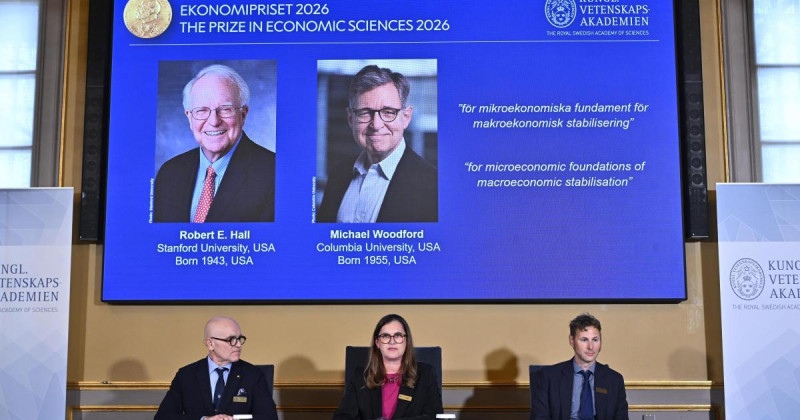
The 2026 Nobel Prize in Economic Sciences was awarded to two titans of the discipline: Robert E. Hall and Michael Woodford. Their work on the microeconomic foundations of macroeconomic stabilization has, in recent times, been celebrated for its profound impact on global economic policy. The duo's models form the bedrock of how central banks and governments navigate economic crises. The award is a testament to the enduring importance of their theories in an era where economic stability is both a challenge and a goal.
From Micro to Macro: Unpacking the Nobel Laureates' Legacy
The Sveriges Riksbank Prize in Economic Sciences, known as the Nobel Prize in Economics, was awarded to the pair for their groundbreaking work on how individual economic decisions impact broader economic trends. This is the kind of work that goes on to shape monetary policies and fiscal strategies worldwide. Their research is particularly relevant in light of the oil crises of the 1970s, which exposed the limitations of traditional Keynesian economic models in managing inflation and unemployment. Hall and Woodford's contributions have provided the necessary frameworks to address these shortcomings, offering a more nuanced understanding of economic stabilization.
Robert E. Hall, a professor at Stanford University, and Michael Woodford, a professor at Columbia University, have spent decades refining these models. Their insights have allowed policymakers to better predict and mitigate economic downturns, making their work a cornerstone of modern macroeconomic theory.
"A huge honor," Woodford says via video link.
The Nobel's Significance in Economic Theory and Practice
The significance of Hall and Woodford's work extends far beyond academic circles. Their models are used daily by central banks and governments to "smooth out" periods of economic instability, making their theories not just theoretical constructs but practical tools. The Nobel Prize is a formal recognition of the transformative impact of their research, a testament to the rigorous and innovative nature of their contributions to the field.
The impact of their work is particularly relevant in the recent economic landscape, where volatility and uncertainty have become the norm. Their models provide a roadmap for navigating these tumultuous waters, offering a beacon of stability in an ever-changing economic environment. The awarding of this prestigious prize underscores the ongoing relevance of their research and the enduring impact of their ideas on economic policy worldwide.