Dwarf Planet Candidate Beyond Pluto Sparks Excitement in Astronomical Community
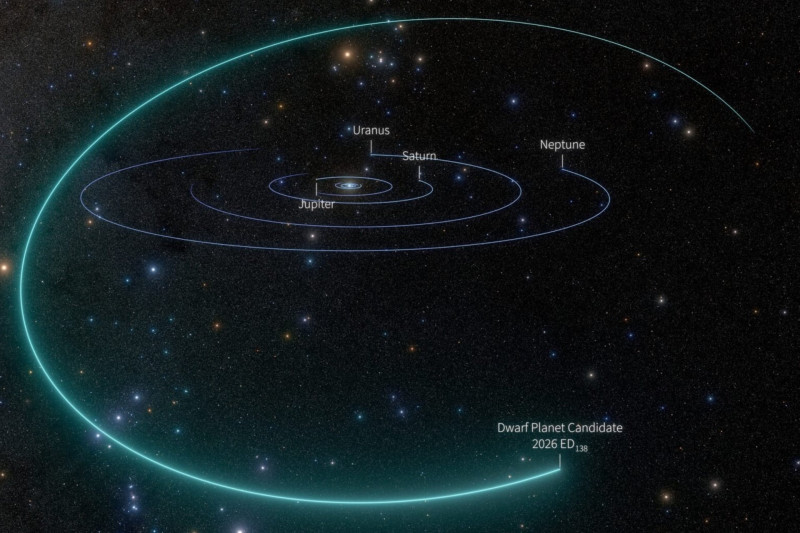
The recent discovery of a possible dwarf planet beyond Pluto has ignited a flurry of excitement and speculation among astronomers around the world. The Vera C. Rubin Observatory, known for its groundbreaking observations, has identified a trans-Neptunian object provisionally named 2026 ED138. If confirmed, this celestial body, which resides in the outer reaches of our solar system, could join the ranks of other recognized dwarf planets such as Ceres, Pluto, Eris, Haumea, and Makemake.
Discovery of a Potential New World
In a major breakthrough, the Vera C. Rubin Observatory has detected a mysterious object orbiting beyond Neptune, adding to the intrigue of our solar system's outer regions. The object, designated 2026 ED138, was spotted during the preparatory runs for the Legacy Survey of Space and Time (LSST). The discovery comes at a time when astronomers are eager to understand the dynamics and composition of objects beyond the orbit of Neptune, in an area known as the Kuiper Belt.
The newly identified dwarf planet candidate, 2026 ED138, could become the sixth such object recognized by the International Astronomical Union. Its discovery is particularly significant as it highlights the capability of the Rubin Observatory to detect and study distant, faint objects.
Astronomers Speculate on the Implications
The identification of 2026 ED138 as a potential dwarf planet has sparked a range of reactions from astronomers. Some are cautiously optimistic, noting that the object meets many of the criteria for dwarf planet status, while others urge further observation and data collection before making any definitive claims.
One intriguing aspect of the discovery is the object's size, which, if confirmed, would be notable among dwarf planets in the outer solar system. The Vera C. Rubin Observatory's advanced technology, coupled with its strategic location in Chile, has proven instrumental in detecting such distant and faint objects. The observatory's powerful telescopes and sensitive detectors allow for precise measurements and detailed observations.
The discovery of 2026 ED138 comes at a time when the dwarf planet debate is far from settled. The classification of these celestial bodies continues to be a topic of intense discussion and research. The International Astronomical Union (IAU) currently recognizes five dwarf planets: Ceres, Pluto, Eris, Haumea, and Makemake. The potential addition of 2026 ED138 to this list could further complicate the debate and prompt a re-evaluation of the criteria used to classify these objects.
The Search for More Dwarf Planets
The search for dwarf planets beyond Pluto is ongoing, with astronomers using advanced telescopes and sophisticated algorithms to sift through vast amounts of data. The Kuiper Belt, a region of the solar system beyond Neptune's orbit, is believed to contain thousands of icy objects, many of which could potentially be classified as dwarf planets.
The Vera C. Rubin Observatory's upcoming Legacy Survey of Space and Time (LSST) is expected to reveal even more about the outer solar system. The survey aims to map the entire southern sky over a decade, providing an unprecedented view of the cosmos and the objects within it. Astronomers hope that the LSST will uncover more dwarf planets and other celestial bodies, offering new insights into the formation and evolution of our solar system.
As scientists continue to study 2026 ED138 and other potential dwarf planets, the excitement in the astronomical community remains palpable. The potential addition of a new member to the dwarf planet family could reshape our understanding of the solar system and prompt a re-evaluation of the criteria used to classify these objects. With the Vera C. Rubin Observatory leading the charge, the search for more dwarf planets is far from over, and the possibilities are as vast as the cosmos itself.
How does this story make you feel?
 Up next · ScienceAstronomers detect new dwarf planet candidate beyond Neptune