Astronomers detect new dwarf planet candidate beyond Neptune
The Vera C. Rubin Observatory identified 2026 ED138, a large trans-Neptunian object that could become the sixth confirmed dwarf planet in the solar system if further observations verify its status.

Key points
- Astronomers detected 2026 ED138, a new dwarf planet candidate located beyond the orbit of Neptune.
- The object was identified by the Vera C. Rubin Observatory in Chile and announced by the Minor Planet Center.
- Initial measurements suggest 2026 ED138 is one of the largest dwarf planet candidates found in this region.
- If confirmed, the object would join Pluto, Eris, Haumea, Makemake, and Ceres as the sixth known dwarf planet.
- The discovery highlights the potential of the Rubin Observatory to find more objects in the Kuiper Belt.
Astronomers have detected a new dwarf planet candidate in the outer reaches of the solar system, beyond the orbit of Neptune. The object, provisionally named 2026 ED138, is being hailed as one of the largest dwarf planet candidates ever discovered in this region.
Discovery of 2026 ED138
2026 ED138 was identified by the Vera C. Rubin Observatory, which has been scanning the skies for new celestial objects beyond Neptune. The discovery was announced by the International Astronomical Union Minor Planet Center (MPC), which is responsible for cataloging such objects. Initial measurements suggest that 2026 ED138 is among the largest dwarf planet candidates ever found in this region.
This discovery is particularly significant because it is one of the first made by the Rubin Observatory, which is located in Chile. The observatory is equipped with advanced telescopes designed to detect faint objects in the outer solar system, making it a powerful tool for discovering new dwarf planets and other celestial bodies.
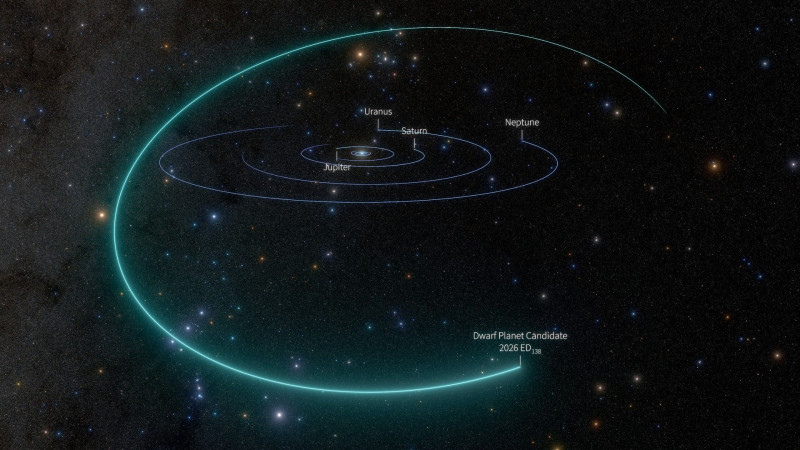
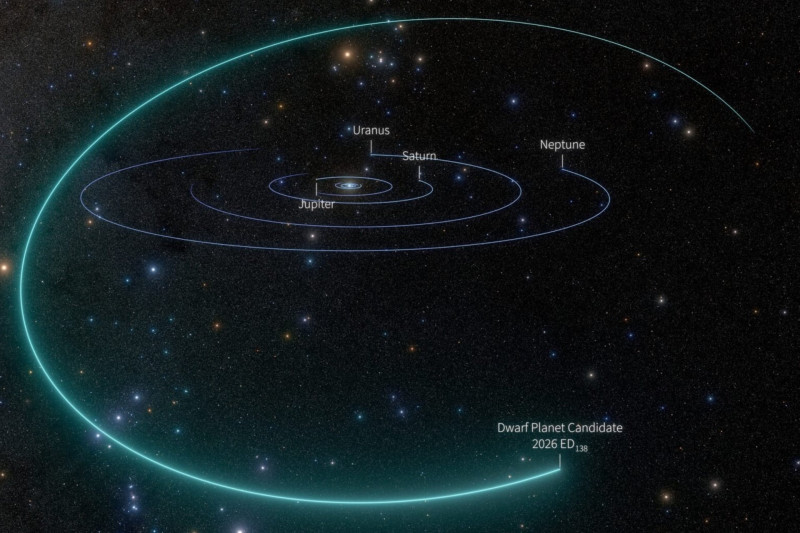
According to the MPC, 2026 ED138 orbits in the outer reaches of the solar system beyond Pluto's orbit.
If confirmed, 2026 ED138 would be the sixth known dwarf planet in our solar system, joining the ranks of Pluto, Eris, Haumea, and Makemake, which orbit beyond Neptune, and Ceres, located in the main asteroid belt between Mars and Jupiter.
The Significance of Dwarf Planets
A dwarf planet is a celestial body that orbits the Sun but is not massive enough to clear its orbit of other objects, unlike the eight major planets in our solar system. Dwarf planets are significant because they provide insights into the formation and evolution of our solar system.
The Kuiper Belt, an area of the solar system beyond Neptune, is home to thousands of known objects, including dwarf planets and other icy bodies. The discovery of 2026 ED138 adds to the growing list of objects in this region, suggesting that there may be even more dwarf planets waiting to be discovered.
The discovery of 2026 ED138 highlights the chaotic nature of the outer reaches of the solar system. Unlike the larger objects closer to the Sun, which orbit in a relatively flat plane, many trans-Neptunian objects orbit the Sun at various angles, expanding the area of sky astronomers need to search.
According to the Vera Rubin Observatory, ED138 is a large, bright trans-Neptunian object.
The Future of Dwarf Planet Research
The discovery of 2026 ED138 is just the beginning. The Vera C. Rubin Observatory is expected to uncover many more dwarf planets and other objects in the outer solar system in the coming years.
As astronomers continue to study these distant worlds, they will gain a deeper understanding of the dynamics and composition of the Kuiper Belt and the outer solar system.
One key development to watch for is the confirmation of 2026 ED138 as a dwarf planet, which will require further observations and analysis. If confirmed, it will be the sixth known dwarf planet in our solar system.
Stay tuned for more updates on the latest discoveries from the Vera C. Rubin Observatory and the ongoing exploration of the outer solar system.
Your questions, answered
What is the name of the new dwarf planet candidate?
The object is provisionally named 2026 ED138.
Which observatory discovered the new dwarf planet candidate?
The Vera C. Rubin Observatory in Chile identified the object.
How many dwarf planets would there be if 2026 ED138 is confirmed?
It would be the sixth known dwarf planet in the solar system.
Quick poll
Should astronomers prioritize searching for more dwarf planets in the Kuiper Belt?
0 votes
How does this story make you feel?
Topics
 Up next · ScienceNew dwarf planet candidate spotted beyond Pluto