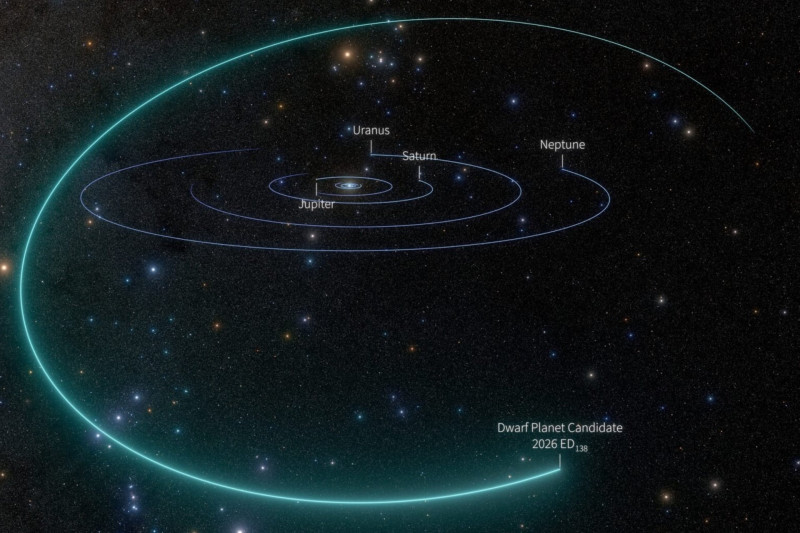
Astronomers spot massive trans‑Neptunian object 2026 ED138 as dwarf‑planet candidate
A new 600‑1500 km icy world was found by the Rubin Observatory, potentially becoming the sixth dwarf planet after further confirmation.

Key points
- The Vera C. Rubin Observatory in Chile identified 2026 ED138, a 600‑1500 km trans‑Neptunian object.
- It lies about 46 times farther from the Sun than Earth, roughly 1.1 billion miles beyond Pluto.
- If its shape is nearly spherical, it could be the sixth dwarf planet recognized by the IAU.
- The discovery was made by Matthew Holman and Kevin Napier using data from the Rubin Observatory.
- The Minor Planet Center announced the candidate on Wednesday.
Astronomers analyzing data from the newly commissioned NSF–DOE Vera C. Rubin Observatory in Chile have discovered a massive trans‑Neptunian object provisionally designated 2026 ED138.
Early analysis suggests the icy world is 600–1500 km across, placing it among the largest celestial bodies found in the outer solar system in more than 20 years.
The object lies about 46 times farther from the Sun than Earth and may measure between 370 to 930 miles wide, roughly 1.1 billion miles farther than Pluto in the Kuiper Belt.
Matthew Holman, a researcher at the Harvard & Smithsonian Center for Astrophysics, made the discovery two weeks ago by running Rubin Observatory data through a program he built with fellow astronomer Kevin Napier.
"My first reaction was one of excited disbelief," Holman said. "Objects like this are very rare, so I immediately started checking whether I or the code had done something wrong."
The International Astronomical Union’s Minor Planet Center announced 2026 ED138 as a candidate on Wednesday.
If continued observations verify that the body’s self‑gravity has molded it into a nearly spherical shape, it could formally become the sixth dwarf planet officially recognized by the International Astronomical Union, joining Ceres, Pluto, Haumea, Makemake and Eris.
The discovery marks the first major planetary candidate detected by the Rubin Observatory’s 8.4‑meter Simonyi Survey Telescope, which began operational commissioning surveys in 2025 atop Cerro Pachón in the Chilean Andes.
Your questions, answered
What is 2026 ED138?
It is a massive trans‑Neptunian object discovered by the Vera C. Rubin Observatory, provisionally designated 2026 ED138.
Could 2026 ED138 become a dwarf planet?
If observations confirm it is nearly spherical, it could be officially recognized as the sixth dwarf planet by the IAU.
How does this story make you feel?
Topics
 Up next · ScienceEmergency Response Underway at Savannah River Site After Lab Fire