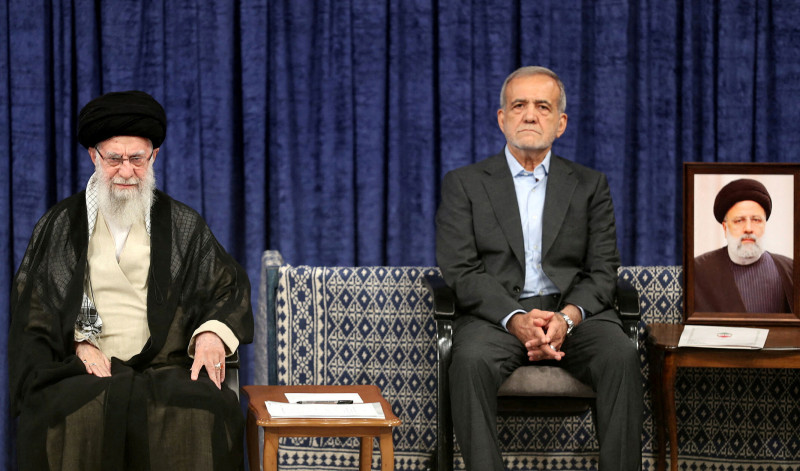
The geopolitical landscape is ablaze with tensions as Iranian President Masoud Pezeshkian describes his country as being in a state of full-fledged war with the United States, Israel, and Europe. This comes in the wake of a series of strikes on Iranian nuclear facilities, which have significantly escalated hostilities.
In a recent interview, President Pezeshkian did not shy away from the escalating tensions, stating that this conflict is more severe than the war Iran faced with Iraq in the 1980s. He emphasized that Iran is better prepared to respond decisively to any further aggression from its adversaries. The Iran-Iraq War, known for its brutality and protracted nature, serves as a grim reminder of the potential for extended and devastating conflict in the Middle East.
The Iranian leader's remarks surfaced just days before a critical meeting between US President Donald Trump and Israeli Prime Minister Benjamin Netanyahu at Mar-a-Lago. The anticipated discussions are expected to focus heavily on Iran, given the ongoing military actions and the broader geopolitical strategy against Tehran. These strikes, which occurred during a twelve-day air war in June, resulted in nearly 1,100 Iranian fatalities, including key military commanders and nuclear scientists.
The Iranian government has also been vocal about the alleged spying activities and opposition ties, highlighting the intricacies of the diplomatic and military strategies at play. Recent actions, including the execution of a man convicted of spying for Israel, underscore the high-stakes nature of the conflict. These developments come as Israel prepares to present a new plan to Trump, further complicating the already tense situation.
Despite the escalating tensions, there is a glimmer of hope for diplomatic engagement. President Pezeshkian has indicated that Iran is open to dialogue with the United States, though he has also been quick to point out the adversarial role of Israel in the current conflict. This dual stance—combining a readiness for dialogue with a firm defensive posture—reflects the intricate balance Iran is attempting to maintain in its foreign policy.
The ongoing conflict between Iran, the US, and Israel is a multifaceted issue that involves not only military actions but also economic sanctions, diplomatic isolation, and covert operations. As these tensions continue to escalate, the international community watches closely, hoping for a peaceful resolution while bracing for the possibility of further escalation. The outcome of the upcoming Trump-Netanyahu meeting will be crucial in determining the trajectory of this complex geopolitical drama.