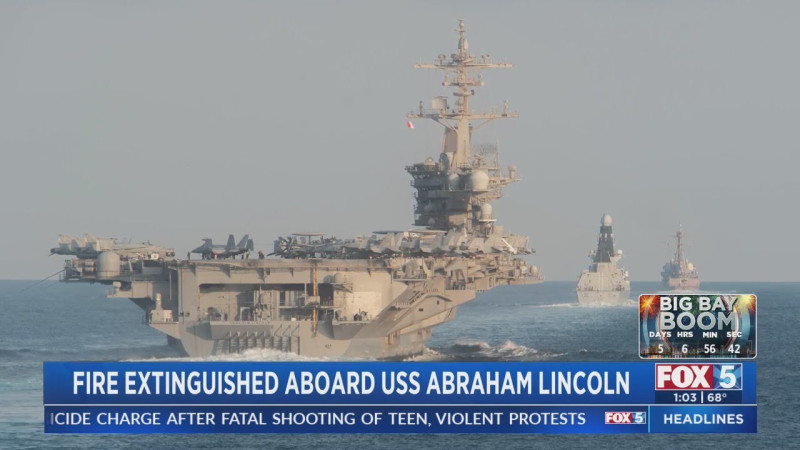
The USS Abraham Lincoln, a San Diego-based aircraft carrier, has found itself at the center of a high-stakes geopolitical drama in the Gulf. The carrier, a key player in the recent coordinated operation against Iran, has been thrust into the spotlight following Iran's Islamic Revolutionary Guard Corps (IRGC) claims of a missile attack.
On Saturday, the USS Abraham Lincoln was involved in a critical operation targeting Iran's nuclear facilities. The operation, part of a broader strategy to counter Iran's perceived aggression, marked a significant escalation in regional tensions. The carrier's role in these operations underscores its strategic importance in U.S. military deployments in the Middle East.
However, the situation took a dramatic turn on Sunday when the IRGC reported that they had launched four ballistic missiles at the USS Abraham Lincoln. The IRGC's statement, which followed U.S. and Israeli strikes against Iranian targets, claimed that the missiles successfully hit the carrier. The alleged attack sent shockwaves through the international community, raising questions about the credibility of Iran's ballistic missile capabilities and the potential for further escalation in the Gulf.
In response to these claims, the U.S. military swiftly denied any impact on the USS Abraham Lincoln from Iranian missiles. The U.S. Central Command asserted that the missiles "didn't even come close" to the carrier. The Pentagon's denial underscores the complexity of the situation and the potential for misinformation and propaganda in times of heightened tension. The conflicting narratives between the U.S. and Iran highlight the need for a thorough investigation into the allegations.
The USS Abraham Lincoln, a Nimitz-class supercarrier, is one of the most advanced and powerful warships in the U.S. Navy. With a cost of approximately USD 4.5 billion, the carrier is equipped with state-of-the-art technology and capabilities, making it a formidable asset in the U.S. military's arsenal. The carrier's involvement in the recent operations and the subsequent claims of an attack have raised questions about the vessel's vulnerability and the effectiveness of U.S. defense systems in the face of advanced ballistic missiles.
The geopolitical implications of the alleged attack on the USS Abraham Lincoln are far-reaching. The incident has the potential to destabilize the fragile balance of power in the Persian Gulf, a region already fraught with tensions. The claims and counterclaims from both the U.S. and Iran highlight the delicate nature of diplomatic relations in the area and the potential for further military confrontations.
As the situation continues to unfold, the international community will be closely watching the developments surrounding the USS Abraham Lincoln and the broader conflict in the Gulf. The carrier's role in ongoing operations and the potential for further escalation underscore the need for diplomatic efforts to de-escalate tensions and prevent a wider conflict.