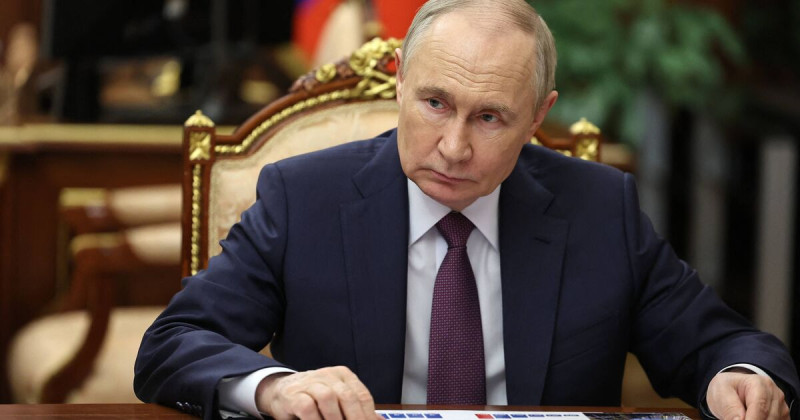
In the ever-shifting landscape of global diplomacy, one name has consistently been a focal point of international intrigue and geopolitical maneuvering: Vladimir Putin. As the world watches the escalating tensions between the US and Iran near the Strait of Hormuz, the Russian President’s involvement adds another layer of complexity to an already tumultuous situation. The latest developments, particularly the renewed interest in peace talks, have placed Putin at the center of a web of diplomatic intrigue and strategic negotiations.
The Role of Russia in the US-Iran Conflict
With the collapse of the recent US-Iran peace talks, the spotlight has turned to Moscow. The Iranian Foreign Minister, Abbas Araghchi, is scheduled to meet with Putin in Russia to discuss the potential for a ceasefire and a diplomatic resolution to the conflict. This meeting comes at a time when the US Navy has begun de-mining operations in the Strait of Hormuz, a critical waterway for global oil trade.
The US President, Donald Trump, has acknowledged that Russia, under Putin’s leadership, may be providing some level of support to Iran during this conflict. In an interview with Fox News, Trump mentioned that Putin’s involvement could be a factor in the ongoing tensions between the US and Iran. This acknowledgment underscores the delicate balance of power in the Middle East, where Russia's influence is increasingly felt.
While the US has long been viewed as a dominant force, the current situation has highlighted the rising influence of the Russia-China-Iran axis. Putin's strategic moves have not only complicated US efforts but have also pushed NATO closer to a potential historic break.
Putin’s Strategic Moves and Their Global Impact
The geopolitical chessboard is a complex field of maneuvering where every move has global reverberations. Putins’s strategic moves in the Middle East have implications far beyond the immediate conflict. The US's tariff threats and the potential for severe economic sanctions against Russia have added another layer of tension to the already strained relations between Moscow and Washington.
The collapse of the US-Iran peace talks has left the international community in a state of uncertainty. With the US-Iran conflict reaching a critical point, Putin’s upcoming meeting with the Iranian Foreign Minister is expected to reveal more about Russia’s intentions and its role in the conflict. While the US continues to assert its influence, the involvement of Russia and China could reshape the future of Middle East politics.
The collapse of the peace talks and the resulting US-Iran tensions have also had a significant impact on the global oil market. The recent surge in Brent crude prices to $107 per barrel is a direct result of the uncertainty in the region. As the situation unfolds, the world watches closely, hoping for a resolution that can bring stability to the Middle East.
Let’s not kid ourselves, the world is on edge. Putin’s involvement in the US-Iran conflict is a clear indicator of the shifting power dynamics in global politics. As the US and Iran grapple with the potential for a ceasefire, Putin’s strategic moves continue to play a significant role in shaping the outcome of the conflict. This raises the question of how far Russia is willing to go to assert its influence in the Middle East and what the implications might be for the broader international community. Here’s what nobody’s asking: could Putin’s involvement be a catalyst for a broader geopolitical realignment, where Russia emerges as a key player in the Middle East?
Counter Argument: The US Perspective
On the other side of the debate, some experts argue that the US has been too lenient in its approach to Iran. They believe that a more aggressive stance could have prevented the current situation. However, others counter that the US’s military might should be tempered with diplomacy, a stance that has been criticized by Trump for being too weak.
The reality is that the current situation is far from simple, and the diplomatic efforts of Russia and the US are intertwined in a complex web of geopolitical strategy. The outcome of the ongoing negotiations and the role of Putin in the conflict will undoubtedly shape the future of the Middle East and global politics.
In this high-stakes game of global diplomacy, Putin’s involvement in the US-Iran conflict is a testament to the shifting power dynamics in international relations. As the world holds its breath, the outcome of the ongoing negotiations and the potential for a ceasefire will reveal the true extent of Putins global influence.