Imagine a country where the echoes of a colonial past still whisper through the sprawling teak forests, while the murmur of political unrest simmers just beneath the surface. This is Myanmar, a land that has weathered storms of change and conflict, yet still retains a beauty that is both timeless and troubled. Myanmar, also known as Burma, is a country in the northwest of Southeast Asia, nestled between the towering Himalayas and the vast expanse of the Bay of Bengal.
History of Myanmar: From Colonial Rule to Modern Strife
The history of Myanmar is a complex tapestry woven with threads of colonial rule, independence, and ongoing political turmoil. Myanmar was a British colony until 1948, when it gained its independence . However, its post-independence journey has been marred by unrest and conflict, with the military playing a dominant role in the country's affairs . The country has seen various governments, including military juntas, and has only recently begun to transition towards a more democratic system, albeit with significant challenges.
One of the most significant events in Myanmar's modern history was the renaming of the country from Burma to Myanmar in 1989. This change reflected a broader shift in the country's identity and political landscape . The name Myanmar, or Myanma in the Burmese language, has been used since the 13th century, and the official English name change was part of a wider effort to assert national identity and independence from colonial legacies . While some countries and organizations still refer to the country as Burma, the official name remains Myanmar, reflecting the country's complex relationship with its past and present.
Cultural Identity: The Burmese and their Heritage
The Burmese people, known for their resilience and rich cultural heritage, form the backbone of Myanmar's society. The country is predominantly Buddhist, with over 80% of the population identifying as such, making it one of the most religiously homogenous countries in Southeast Asia . Buddhism plays a central role in the daily lives of the Burmese, influencing everything from art and architecture to social customs and traditions. Myanmar's large number of Buddhist monks, as a percentage of the total population, underscores the deep-rooted nature of the faith .
Language is another key facet of Myanmar's cultural identity. The Burmese language, also known as Bamar or Myanmar, is the official language and is spoken by the majority of the population. It belongs to the Tibeto-Burman language family and is written using a unique script that has evolved over centuries . The Burmese language is not only a means of communication but also a repository of the country's rich literary and poetic traditions.
Myanmar's cultural landscape is also shaped by its diverse ethnic groups, which include the Karen, Shan, and Rakhine, among others. Each of these groups has its own language, traditions, and customs, contributing to the country's rich cultural mosaic. However, ethnic tensions and conflicts have long plagued Myanmar, with various ethnic groups seeking greater autonomy and recognition from the central government.
Geography and Economy: From Golden Pagodas to Economic Challenges
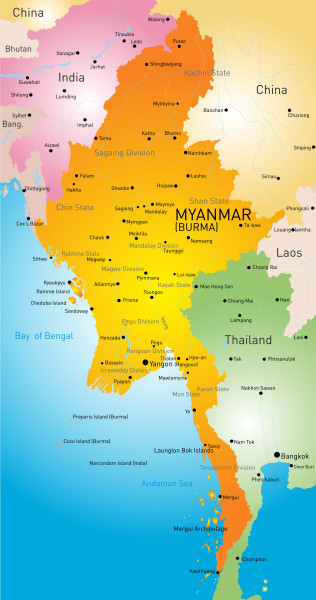
Geographically, Myanmar is a land of contrasts, with lush mountains, vast plains, and golden pagodas dotting the landscape. The country is bordered by India and Bangladesh to the northwest, China to the northeast, and Laos and Thailand to the east, making it a strategic crossroads in Southeast Asia . Myanmar's diverse geography supports a wide range of ecosystems, from the tropical rainforests of the south to the snow-capped peaks of the north.
The economy of Myanmar, however, faces significant challenges. Despite being the second-largest country in Southeast Asia, with a population of over 50 million, Myanmar remains one of the least economically developed countries in the region . The country's economy is heavily reliant on agriculture, with rice being a major export. However, Myanmar's natural resources, including oil, gas, and minerals, offer potential for economic growth and development . The country's strategic location and rich resources have also made it a target for foreign investment, although political instability and corruption have long hindered economic progress.
In recent years, Myanmar has taken steps to open its economy and attract foreign investment. The government has implemented economic reforms, including the liberalization of certain sectors and the easing of restrictions on foreign investment. However, the country still faces significant economic challenges, including high levels of poverty, inadequate infrastructure, and a lack of skilled labor.
Despite these challenges, Myanmar has made significant strides in recent years, particularly in the areas of education and healthcare. The country has seen improvements in literacy rates and access to healthcare services, although significant disparities remain between urban and rural areas. Myanmar's progress in these areas reflects the country's long-standing commitment to social development and the well-being of its people.
Myanmar's journey is one of resilience and hope amidst the shadows of conflict and political turmoil.
The resilience of the Burmese people is evident in their ability to navigate the country's tumultuous political landscape while preserving their rich cultural heritage,writes an expert in the New York Times . The country's future remains uncertain, but there is a glimmer of hope that it will emerge from its struggles to become a stable and prosperous nation. As Myanmar continues to navigate its path, the world watches with bated breath, hoping for a brighter future for this land of contrasts and tensions.