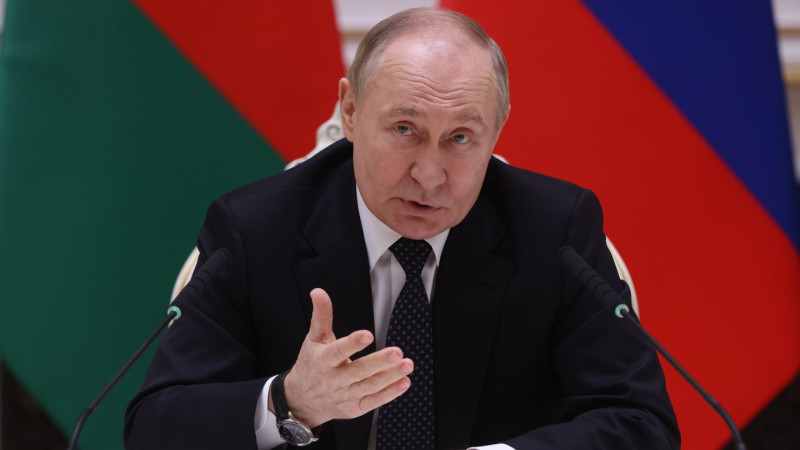
The Russia-Ukraine war continues to dominate global headlines, with Russian President Vladimir Putin's recent statements hinting at a possible de-escalation of the conflict. Putin has suggested that the war, which has been ongoing for four years, is "coming to an end," a sentiment echoed in multiple reports .
The Endgame: Putin’s Remarks and Their Implications
Putin's remarks, delivered just hours after Moscow’s scaled-back Victory Day parade, have sparked a mix of hope and skepticism. The Russian President's optimism stands in stark contrast to the ongoing conflict on the ground, where the fighting continues unabated. The Kremlin’s statement, suggesting that the war is “coming to an end,” comes amidst a backdrop of escalating tensions and recent military engagements. Putin's assertion that the conflict is a "serious matter" underscores the gravity of the situation, despite his optimistic outlook .
Putin has also accused Western nations of prolonging the war by providing support to Ukraine, suggesting that a resolution would require a significant shift in international backing for Kyiv. This perspective adds a layer of complexity to the geopolitical dynamics at play, as the U.S. and Europe continue to bolster Ukraine’s defenses in the face of Russian aggression.
Ukraine’s Response and Resilience
Ukrainian President Volodymyr Zelenskyy has maintained a firm stance against Russian aggression, emphasizing his country’s determination to resist. Ukraine has seen a surge in support from the international community, with Western nations providing military aid, humanitarian assistance, and diplomatic backing. This support has been crucial in sustaining Ukraine’s defense against Russian advances.
However, the war has taken a heavy toll on Ukraine, with significant loss of life, infrastructure destruction, and a massive influx of refugees. Despite these challenges, Ukraine has shown remarkable resilience, with its people and leadership remaining steadfast in their fight for sovereignty. The conflict’s humanitarian impact has been profound, with millions displaced and countless lives uprooted.
The Path Forward: Negotiations and Uncertainty
While Putin’s remarks could signal a potential shift in Russia’s stance, the path to peace remains fraught with uncertainty. The Kremlin has indicated that the next steps toward resolution would require European governments to make the first move, complicating negotiations and prolonging the stalemate. The international community, meanwhile, continues to urge both sides to engage in meaningful dialogue to end the conflict.
“The war in Ukraine challenges our understanding of war and peace, order and chaos. It is a conflict that goes beyond borders and threatens the stability of the entire region,” said a senior analyst at the Council on Foreign Relations, highlighting the broader implications of the conflict.
The ongoing conflict has also highlighted the strategic importance of Ukraine, with its control over key resources and territorial access. Russia’s ambitions in the region have been a long-standing source of geopolitical tension, and the current conflict underscores the enduring significance of Ukraine’s sovereignty.
Here's what's nobody's asking: will the world's attention waver, or will Ukraine continue to draw international support and resources? It is clear that Ukraine will need sustained backing to rebuild and defend itself against future threats.
The Russia-Ukraine war is a complex and evolving situation, with far-reaching implications for global security and stability. As the conflict continues to unfold, the world watches with bated breath, hoping for a resolution that brings peace to the region and security to Ukraine’s people. As Putin stated, "Russia's war in Ukraine is a serious matter".